
Small Call to Action Headline
BLACK HAMMOCK FARM FAMACA SCORING SYSTEM
MESSAGE FROM THE OWNER
FAMACHA scoring is a critical management tool that allows Black Hammock Farm to make selective deworming decisions based on estimated anemia levels in our sheep caused by barber pole worm infection. This blood-feeding parasite is the most economically important parasite affecting pasture-based sheep production, and worldwide anthelmintic resistance has been reported in all current dewormers. The FAMACHA system helps slow the rate of drug-resistant parasite development by identifying which specific animals need treatment rather than deworming the entire flock. This guide teaches you the proper scoring technique, when to assess, and how to make treatment decisions that protect both animal health and dewormer effectiveness.
What IS FAMACA Scoring?
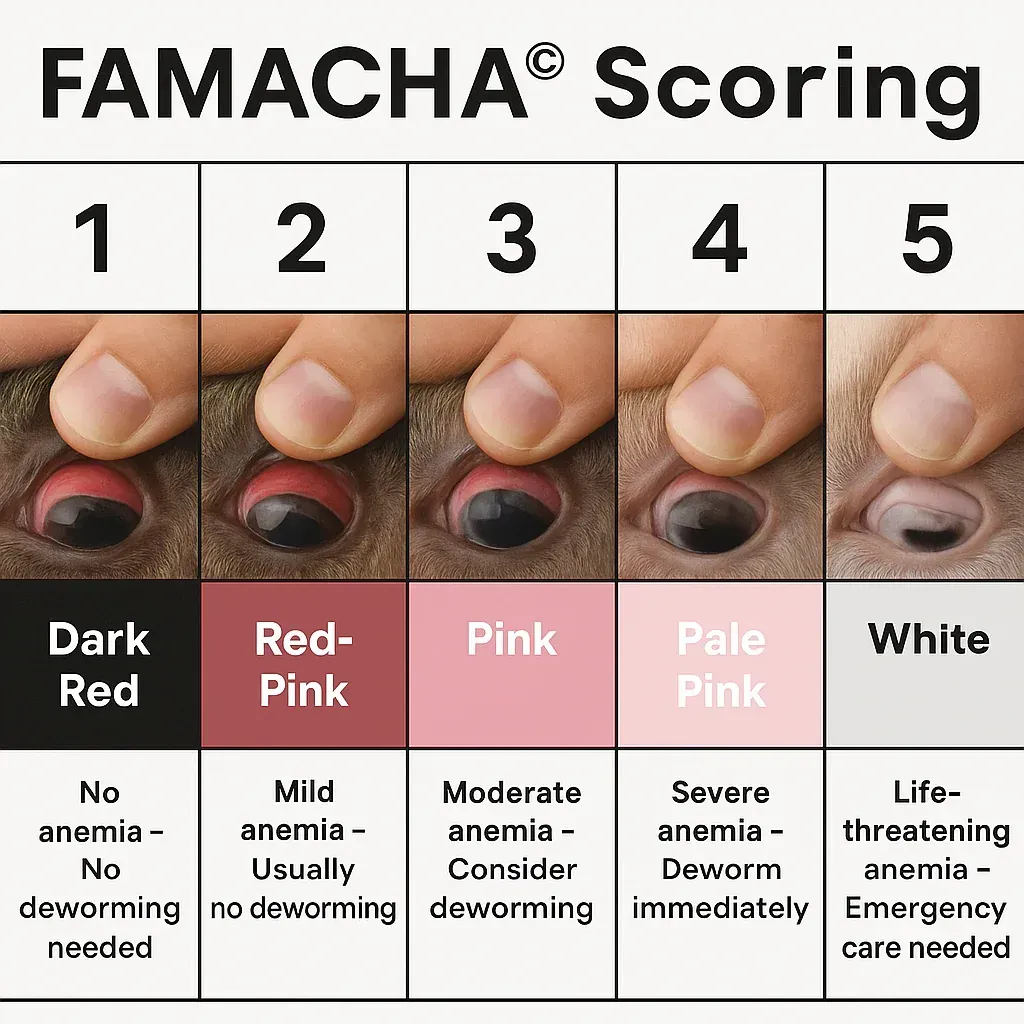
FAMACHA is a color-coded card system developed in South Africa that matches the color of eye mucous membranes in sheep and goats with a laminated chart showing five color categories corresponding to different levels of anemia. Category 1 (red) represents an animal that is not anemic, while Category 5 (pale white) represents a severely anemic animal.
The FAMACHA Scoring Scale
The FAMACHA system uses a 1-to-5 scale based on lower eyelid mucous membrane color:
Score 1 - Red (Healthy)
Dark red eyelid membrane indicating no significant anemia
PCV >28% (healthy red blood cell count)
Action: No treatment needed
Score 2 - Red (Healthy)
Light red to pink coloration
PCV 23-27%
Minimal parasite burden
Score 3 - Red (Healthy)
Light red to pink coloration
PCV 23-27%
Minimal parasite burden
Score 4 - Red (Healthy)
Pinkish-white coloration indicating moderate to severe anemia
PCV 13-17%
Heavy parasite burden
Action: Deworm immediately
Score 5 - Red (Healthy)
White color indicating severe, life-threatening anemia
PCV <12% (deadly range)
Critical parasite burden
Action: Deworm immediately and provide supportive care
When To FAMATCH SCORE
Sheep should be FAMACHA scored every 1 to 3 weeks during peak Haemonchus contortus transmission season. When scores trend higher indicating growing infection, animals should be scored every 7-10 days.
Frequency Guidelines:
Peak Parasite Season: (Warm, Humid Weather
• Every 7-14 days minimum
• Weekly if more than 10% of flock scores 4 or 5
Moderate Risk Periods:
• Every 2-3 weeks
• After heavy rainfall or temperature increases
Low Risk Periods (Cool, Dry Weather):
• Monthly assessments
• May suspend when only 2% score 3 or higher
Critical Times to Score:
• After moving to new pasture
• During and after lambing (ewes under stress)
• Weaned lambs (highly susceptible)
• Any time animals show signs of illness
• Before and after breeding season
Environmental Triggers:
• Following periods of warm, wet weather
• When pasture is lush and green
• After animals have been on same pasture for 30+ days
Treatment Decision Based on FAMACHA Scores
In general, animals scoring 3, 4, or 5 are treated with a chemical dewormer, while animals scoring 1 or 2 are not treated unless other signs of parasitism are observed.
Score 1-2: DO NOT DEWORM
Optimal body condition:
• These animals are handling parasite burden effectively
• Treating them unnecessarily contributes to resistance
• Continue monitoring on regular schedule
Score 3: CONDITIONAL TREATMENT
Consider these factors when deciding whether to deworm Score 3 animals:
• Deworm Score 3 if animal is:
• Young lamb (under 6 months)
• Lactating ewe
• In poor body condition
• On poor quality feed
• Showing other signs of illness
• Pregnant in late gestation
• May wait and recheck Score 3 if animal is:
• Strong adult in good body condition
• Not lactating
• On good quality feed
• No other health concerns
• Must recheck in 7 days•
Score 4-5: ALWAYS DEWORM IMMEDIATELY
BCS guides specific feeding interventions:
• These animals are at serious risk and should always be dewormed with effective drugs
• Provide additional nutritional support
• Remove from heavily infected pasture if possible—animals dewormed and returned to the same contaminated pasture will take extended time to recover
• Monitor closely and may need retreatment
• Consider culling animals that consistently score high
Critical Limitations
FAMACHA matches up specifically with concerns about Haemonchus contortus, a blood-sucking parasite where heavy infestations result in anemia. It does NOT detect:
• Tapeworms
• Coccidia
• Other gastrointestinal nematodes that don't cause anemia
• Liver flukes (though these can cause anemia, requiring different management)
Every Animal Must Be Scored
Research demonstrates that 20% of animals in a flock can carry 60-80% of the worm load. Spot-checking a few animals and using that to determine treatment for the entire flock is not correct use of FAMACHA and will not provide accurate information.
Card Must Be Used Every Time
Correct use of the FAMACHA system requires that the scorecard is used each time eyes are checked. Don't rely on memory or estimation—color perception varies, and consistency requires the reference card.
Part of Integrated Parasite Management
FAMACHA is most effective when used within an overall parasite control strategy that takes into account the biology and lifecycle of the parasite. It should be combined with:
• Pasture rotation and management
• Fecal egg counts (periodic)
• Body condition scoring
• Proper nutrition
• Breeding for parasite resistance
• Strategic grazing management
How to Use This Chart Effectively:
Before you start work, review the chart to see where animals currently stand. After assessments, don't just write scores and walk away—take a moment to discuss findings with whoever is working next. Ask questions: "Why is ewe 1971 holding condition better than 1972 when they're in the same group?" "Should we separate lamb #3 for additional feed?" These conversations, supported by documented data, are what transform numbers into actionable management decisions.
The Bottom Line:
The chart is a tool, but communication is the skill. Record accurately, share observations promptly, ask questions when scores don't make sense, and never assume someone else will notice a problem. Every conversation about body condition scores strengthens our ability to keep every animal thriving. When in doubt, speak up—your observations matter, and together we ensure no animal falls through the cracks.
1579 Walsh Street Oviedo,
Florida 32765
COMPANY
FARM SERVICES
LIVESTOCK PROGRAMS
FOLLOW US


POWERED BY:

© 2025 Black Hammock Family Farm. All rights reserved.
1579 Walsh Street Oviedo,
Florida 32765
COMPANY
FARM SERVICES
LIVESTOCK PROGRAMS
FOLLOW US
POWERED BY:
© 2025 Black Hammock Family Farm.
All rights reserved.