
Small Call to Action Headline
BLACK HAMMOCK FARM FEED SCHEDULE
MESSAGE FROM THE OWNER
Every successful sheep operation runs on consistency, and nowhere is that more critical than in your daily feeding routine. Whether you're stepping into the feed room at dawn or checking water troughs before sunset, the decisions you make about nutrition directly impact flock health, lamb growth rates, and your farm's bottom line. This guide walks you through Black Hammock Farm's proven feeding strategies—from calculating precise feed amounts for different life stages to organizing an efficient feed room that saves time and prevents costly mistakes. You'll learn the daily routines that keep our Katahdins thriving, the weekly priorities that prevent nutritional gaps, and the seasonal adjustments that align feeding programs with breeding cycles and market demands. Master these fundamentals, and you'll build the foundation for a healthy, productive flock that performs year-round.
Feed Schedule
Daily Routine
1.) Feeding (See Feed Chart)
Back chicken outside chicken's 1st.
Pigs
Bubba and the boys
Vector and the boys
Waffles and Daisy
Back chickens
Front Chickens
Walk sheep to back pasture
Refill - Hay
2.) Water (Clean Water)
Bubba and the Boys
Interior Sheep Stalls
Back Chicken
Pigs
Exterior Sheep Holding Pens
Main Out Pen
Biys
3.) Stalls
Sweep out feed room
Sweep out interior pin
Sweep out sheep hut from main pen
Rake off poop from holding pins
rake up hay from the main pen
4.) Collect Eggs From All Coups
Back Chicken Coop (Tires, Hutches)
Sheep Hay Feeders (Vectors Mainly)
Milk Crate (Inside Main Feed House)
Front Coop Small Side (Floor Binds)
Front Coop Four Doors
Note: There are wooden eggs. They are marked and are lighter than eggs. Leave.
5.) Restock: You need to make sure all feed is restocked by the time you leave on Thursday
See Feed Room Plan
6.) Daily Observation and needs list
7.) Clean Up: Pick after yourself and put stuff away that you use. Cleanliness is next to Godliness.
Weekly Priorities
Clear Interior Sheep Stalls
Clean Sheep Main Holding Pens
Clean Exterior Stalls
Clean Back Chicken Coop
Clean Front Chicken Coop
Clean and scrub all water bowls
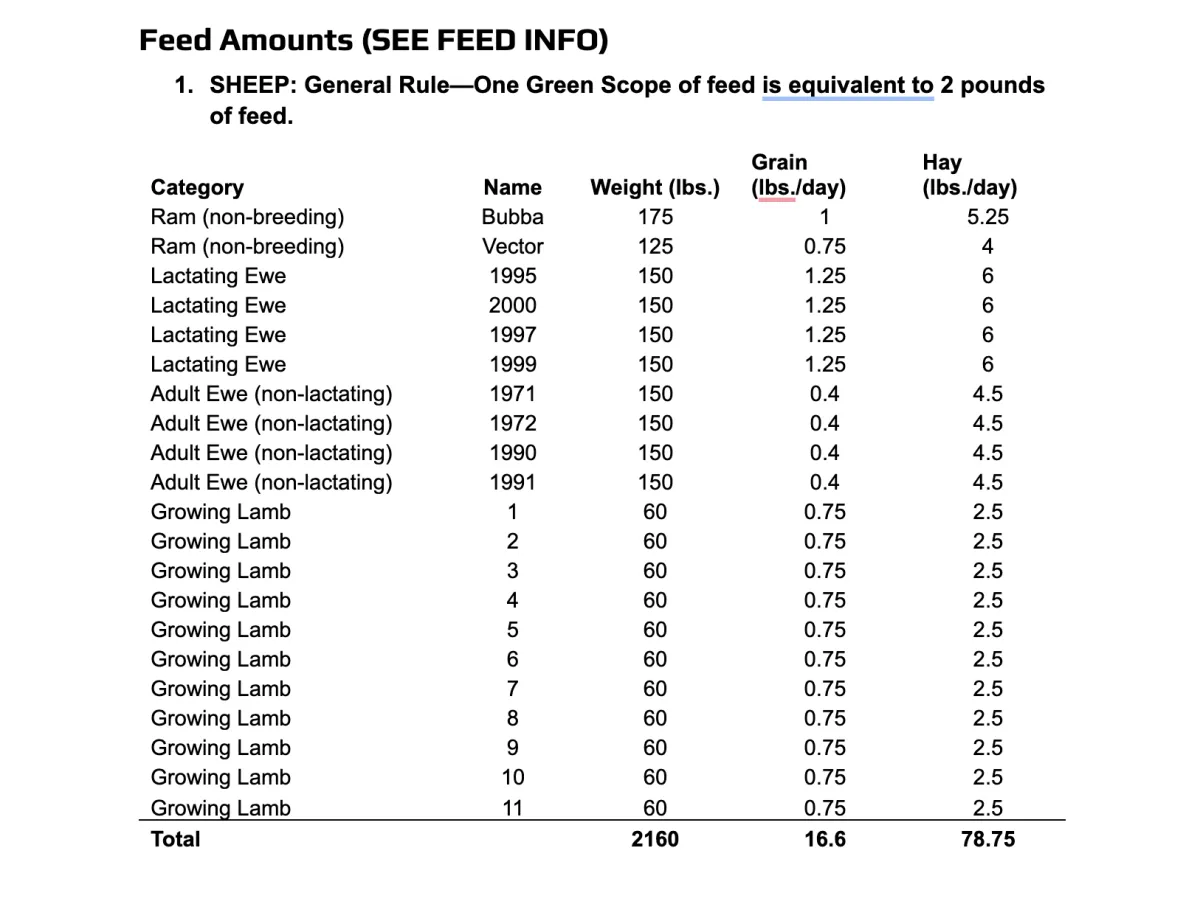
Example 1:
If you are feeding Bubba an Adult A Ram (Non-Breeding) and Two Growing lambs, the total feed amount would be 2.5 LBS or the equivalent to 1 ¾ green scoops and two flakes of hay.
Example 2:
If you are feeding Vector an Adult A Ram (None Breading), the total feed amount would be 1 LBS or the equivalent to ¾” of a green scoop and one flakes of hay.
Example 3:
If you are feeding Stephanie an Adult Ewe (Lactating), the total feed amount would be 1 LBS or the equivalent to ¾” of a green scoop and one flakes of hay.
Example 4:
If you are feeding 5 Adult Ewe (non-Lactating), the total feed amount would be 2 LBS or the equivalent to ¾” of a green scoop and three flakes of hay.
2.) Turkey
Alway try to seperate turkeys from chickens before you feed. Half scoop corn and half scoop high protine
3.) Pigs
a. Pen 1- Blue Bucket 2 and Scoop 1/2 of all stock and scoop of corn
4.) Chicken
a. Main Gangsters - Full scoop of egg layer and 1/3 scoop of corn
b.) H1- 1/2 scoop egg layer and 1/3 scoop of corn. This will be given to the turkey., dick rooster, cooper marins.
c.) H2- Full scoop egg layer and 1/3 scoop of corn. Two full scoops of feed located in H3 with 1 scoop of scratch. Should be put in Troths.
d.) H3- Full Scoop egg layer and 1/3 scoop corn.
Pasture Rotations
1. Sheep from pen 4 will always go to pasture A. no more than 10 in pasture A. The only exception here is the wet season or during heavy rains. Put in Paddox C or Pasteur D or C.
2. Pen 3 will alternate between Pasture C & D.
Feeding Instructions
Katahdin Sheep Daily Feeding Requirements
🌾 Grain (Concentrate) Recommendations
Grain should be a supplement, not the main feed. It is primarily used during high nutritional demand periods (e.g., lactation, breeding) or when forage is poor.
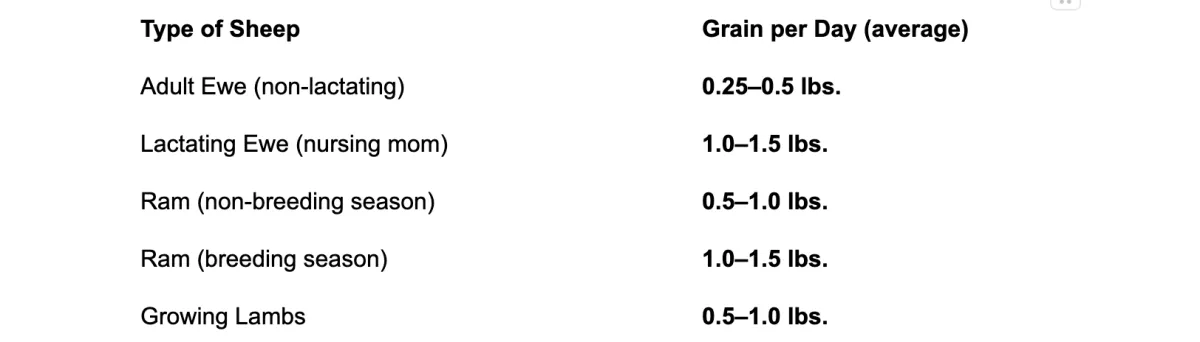
⚠️ Tip: Grain should not exceed 50% of the total diet (on a dry matter basis). Always introduce grain gradually to avoid acidosis.
Source: University of Main, Pen State, Kentucky, Langston University Sheep Program
🌿 Forage (Pasture or Hay) Requirements
Sheep consume 2.5–3.5% of their body weight in dry matter each day. Forage needs vary by weight and physiological status.

🧮 Additional Considerations
• The quality of hay or pasture makes a big difference. High-quality alfalfa hay has more protein and energy than low-quality grass hay.
•Supplements like mineral blocks (esp. for selenium, copper in low levels) should be available.
• Water access is critical, especially for lactating ewes, as their water intake increases significantly.
•🍼 Lactating ewes need up to 50% more forage to support milk production.
Primary Feeding Strategies:
🥬 Hay & Pasture as Primary Feed
Katahdin sheep are well-suited for forage-based diets. Most of their nutritional needs — even for lactating ewes and growing lambs — can be met with high-quality pasture or hay, especially when:
• You rotate pastures to keep forage fresh.
•You provide legume-rich hay like alfalfa or clover for lactating ewes.
• The hay or pasture is well-balanced in protein and energy.
🌾 Grain: A Strategic Supplement
Grain should only be added when:
• Pasture is poor or unavailable (e.g., winter or drought).
•Ewes are lactating, especially with twins or triplets.
• Lambs are growing rapidly and need extra calories.
•You're preparing rams for breeding season.
👉 In these cases, grain helps meet increased energy demands, but you can keep it limited — usually under 1.5 lbs./day per sheep.
✅ Ideal Feeding Strategy
For your 22-sheep operation:
• Use rotational grazing and/or hay as the foundation of their diet.
•Provide free-choice minerals and clean water daily.
• Add grain selectively:
- Lactating ewes – up to 1.25–1.5 lbs./day
- Lambs (creep feed) – 0.5–1.0 lbs./day
- Rams (seasonal) – 0.5–1.0 lbs./day when conditioning
Seasonal Adjustments
• Spring/Summer: Rely more on pasture.
•Fall/Winter: Transition to hay, with grain support as needed.
Would you like a printable chart showing when and how to supplement grain, based on life stage or season?
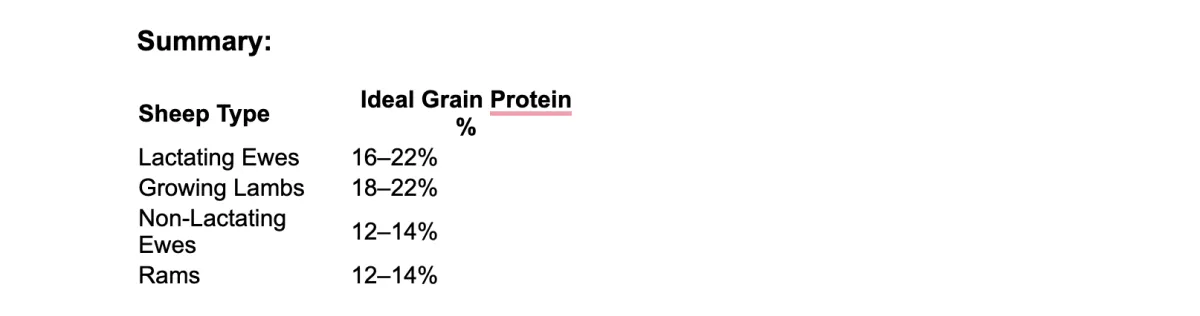
Protein Percentage in Grain: Why It Matters
Sheep need different levels of protein depending on their life stage and purpose. Grain is often used to fill in gaps that forage or hay can't cover — and protein is one of the most critical nutrients during growth, lactation, and pregnancy.

🍼 When to Use High Protein Feed (16–22%)
• Lactating ewes: Milk production demands high protein intake. A 20–22% protein grain helps support lactation, especially with twins/triplets.
•Weaned lambs: Need high-protein creep feed (18–22%) for muscle development and fast growth.
•Late-gestation ewes (last 6 weeks): Fetal development spikes; protein needs increase.
🟢 Recommended: Use lamb & ewe feed (20–22%) for these groups.
🐏 When 13% All-Stock Is Okay
• Adult rams (non-breeding season)
•Non-lactating, mature ewes with access to good forage
•As a calorie supplement, when hay or pasture is high in protein
🟡 Caution: Feeding only 13% grain to lactating ewes or lambs can lead to poor growth or milk production, unless hay/pasture quality is exceptional.
⚠️ Important Notes
•Overfeeding high-protein grain can lead to urinary calculi in rams/wethers, especially with excess phosphorus.
•Balance grain intake with forage quality — if your pasture is lush and legume-heavy, you may not need high-protein grain.
•Always offer a free-choice mineral formulated for sheep, especially if feeding grain.
Summary:
Would you like help designing a custom feed blend or rotation based on your local forage quality and grain access?
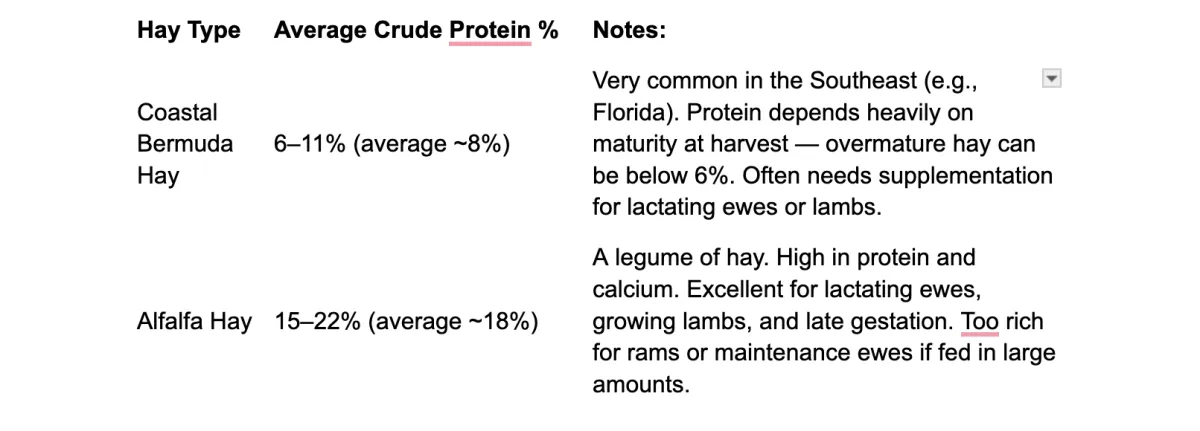
🌾 Crude Protein Content in Common Hays
🌿 Feeding Notes:
Coastal hay is a great maintenance forage for non-lactating ewes and rams, but often too low in protein for lambs and lactating ewes unless supplemented with grain or legume hay.
Alfalfa hay can often eliminate the need for grain in lactating ewes if fed in sufficient quantity, but it
Blending Coastal + Alfalfa is a common approach to balance protein and reduce feed costs.
Example Feed Strategy:
If you're feeding Coastal hay (~8% protein):
Supplement with grain at 16–22% protein for lambs and lactating ewes.
If feeding Alfalfa hay (~18%):
You may be able to reduce or eliminate grain for lactating ewes.
Use with caution for rams or non-lactating sheep due to calcium-phosphorus balance risks.
Awo-stand squared bale of hay is 50 pounds and contains 13 – 15 flakes. The total weight is 50 pounds, and the flake weight approximately 3.8 lbs.
A Three stand squared bale of hay is 100 pounds and contains 26 – 30 flakes. The total weight is 50 pounds, and the flake weight approximately 3.8 lbs.
🌿 Pasture Time vs. Grain Supplementation Reduction
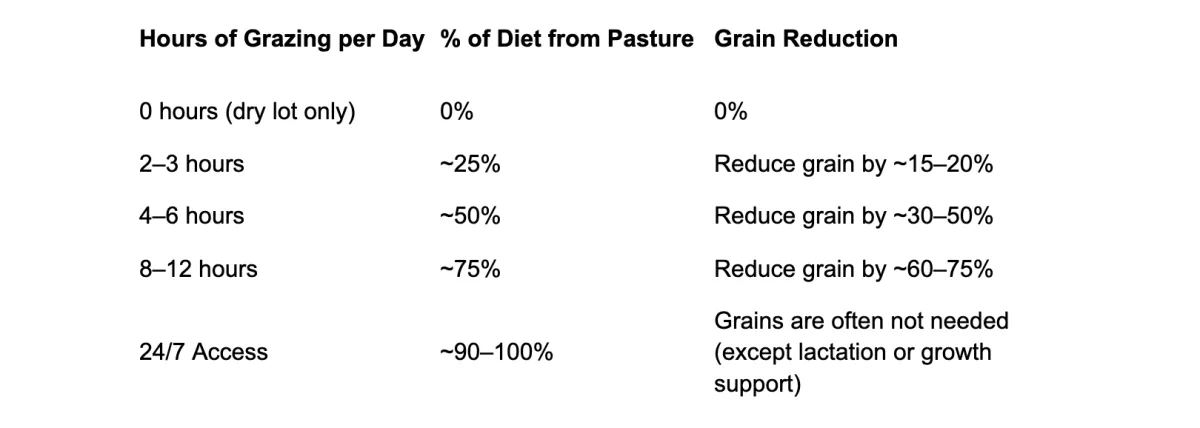
You can absolutely adjust grain requirements based on pasture access, and while it’s not an exact formula like a mathematical equation, there are well-established guidelines used by universities and sheep nutrition experts.
🧮 General Rule of Thumb:
Every 4–6 hours of good-quality pasture grazing can reduce grain requirements by 30–50%.
This assumes:
•The pasture is actively growing and high quality (≥16–20% dry matter).
•Stocking density is reasonable.
•The sheep are healthy and not competing for forage.
📊 Grain Reduction Based on Pasture Hours
Hours of Grazing per Day % of Diet from Pasture Grain Reduction
🐑 Application Example
Every 4–6 hours of good-quality pasture grazing can reduce grain requirements by 30–50%.
Say you're feeding:
•A Lactating ewe normally gets 1.25 lbs. of grain/day.
If she grazes 6 hours/day on decent pasture:
•You can reduce grain by 50% → new ration: 0.6–0.7 lbs./day grain
•Possibly more if the pasture is high in legumes (e.g., clover)
⚠️ Important Caveats
Every 4–6 hours of good-quality pasture grazing can reduce grain requirements by 30–50%.
Say you're feeding:
•If pasture is overgrazed, dry, or low in nutrients, you cannot reduce grain this much — or at all.
•For lambs under 60 days, you still need creep feed regardless of pasture access.
•Always monitor body condition score (BCS) every 2–3 weeks when reducing grain.
✅ Best Practice:
Use a blend of hay, pasture, and grain as needed based on season, weight, and production stage. Maintain flexibility and observe behavior — hungry sheep will vocalize or show signs of weight loss quickly.
📚 Sources
•University of Maine Extension – Sheep Nutrition Basics: https://extension.umaine.edu
•Penn State Extension – Feeding the Ewe Flock: https://extension.psu.edu
•Maryland Small Ruminant Page: https://www.sheepandgoat.com
•University of Kentucky – Ram Management Guide: http://www2.ca.uky.edu
•Langston University – Nutrient Requirements of Sheep: https://www.luresext.edu
•Cornell University – Sheep Program: http://blogs.cornell.edu/sheep
•Oregon State University Extension – Feeding and Nutrition for Sheep: https://extension.oregonstate.edu
•Sheep 201: A Beginner’s Guide to Raising Sheep: http://www.sheep101.info
•Purina Mills – Sheep Mineral Nutrition Guide: https://www.purinamills.com
FEED ROOM
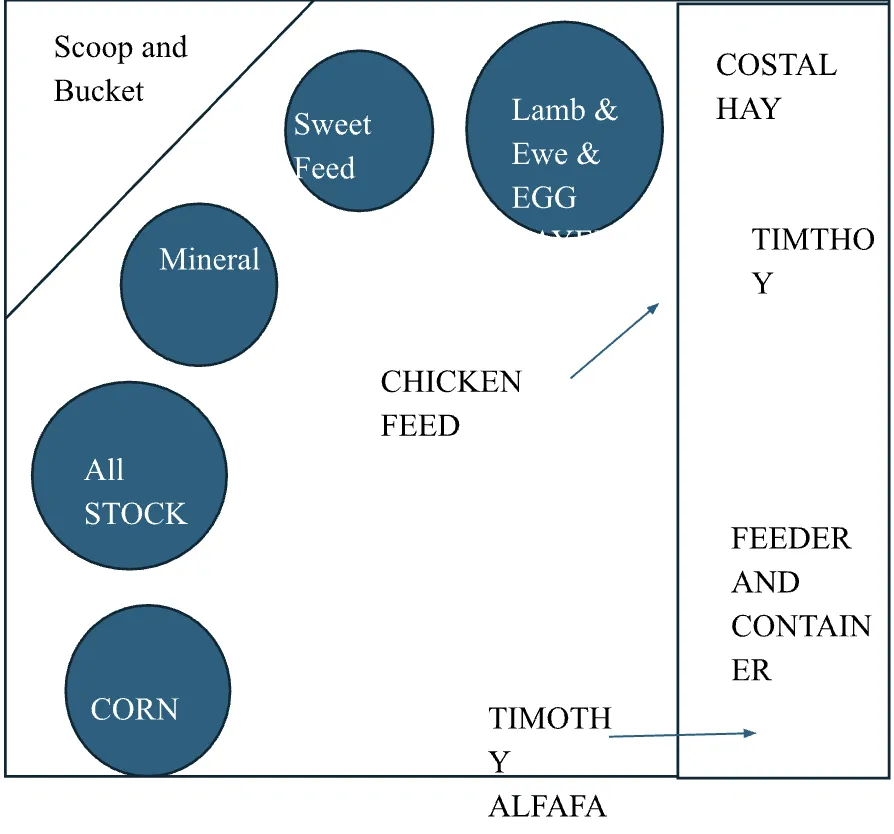
1.) Feed room should always be stocked with the following. If running low, locate feed bags in the house garage. Notify Heidi before it gets low. Should never run out of hay - EVER...........
2.) Stock items
a. (1) Bag of corn
b. (1) Bag of sweet feed
c. (1) Bag of Minerals
d. (1) All Stock
e. (1) Lamb and Ewe
f. (1) Egg Layer
3.) Hay
a. (1) Three Stran Timothy
b. (2) Coastal Hay
c. (2) Timothy Alfa
MINIMAL EQUIPMENT REQUIREMENT PER STALL
EACH SHEEP STALL / PADDOX SHOULD HAVE THE FOLLOWING
(1) Water Bowl
(2) Hay Feeder
(3) Feeding Troth or Table
(4) Mineral Bowl
(5) Shelter
EACH PIG PIN SHOULD HAVE THE FOLLOWING
(1) One food bowl per pig
(2) Watering Troth
(3) Shelter
EACH CHICKEN COOP SHOULD HAVE THE FOLLOWING:
(1) Watering device or bowl
(2) Feed bowl or container
THINGS THAT YOU SHOULD WATCH OUT FOR WITH THE PADDOX, PINS, COOPS, AND FENCES.
*****I WOULD CHECK THESE EVERY DAY********
(1) Main coop - I would check the watering systems. Make sure none of the watering bowls on the pipe line are leaking and I would check to make sure there is water in the blue 50-gallon bucket.
(2) Inspect wire mesh on each coop. Notify Kip if holes or wire are weak due to rust or age.
(3) Would look at fence lines in the paddox for stretch wire or areas they can get hurt.
1579 Walsh Street Oviedo,
Florida 32765
COMPANY
FARM SERVICES
LIVESTOCK PROGRAMS
FOLLOW US


POWERED BY:

© 2025 Black Hammock Family Farm. All rights reserved.
1579 Walsh Street Oviedo,
Florida 32765
COMPANY
FARM SERVICES
LIVESTOCK PROGRAMS
FOLLOW US
POWERED BY:
© 2025 Black Hammock Family Farm.
All rights reserved.