
Small Call to Action Headline
BLACK HAMMOCK FARM PASTURE MANAGEMENT AND CARE
MESSAGE FROM THE OWNER
Effective pasture management is the foundation of Black Hammock Farm's success—transforming 12.5 acres into a sustainable, productive grazing system that supports our Katahdin flock year-round. What animals graze, how, when, and for how long they graze a pasture determines the species make-up of the pasture and its long-term viability, how much forage it yields, and how well the animals perform. Well-managed controlled grazing programs can increase quality forage production by 30-70% each year compared to continuous grazing. This guide teaches you our seasonal rotation strategy, individual pasture characteristics, daily management protocols, and emergency procedures—ensuring every team member understands how to protect both our land and our livestock through Florida's demanding climate.
Understanding BHF PAsture System
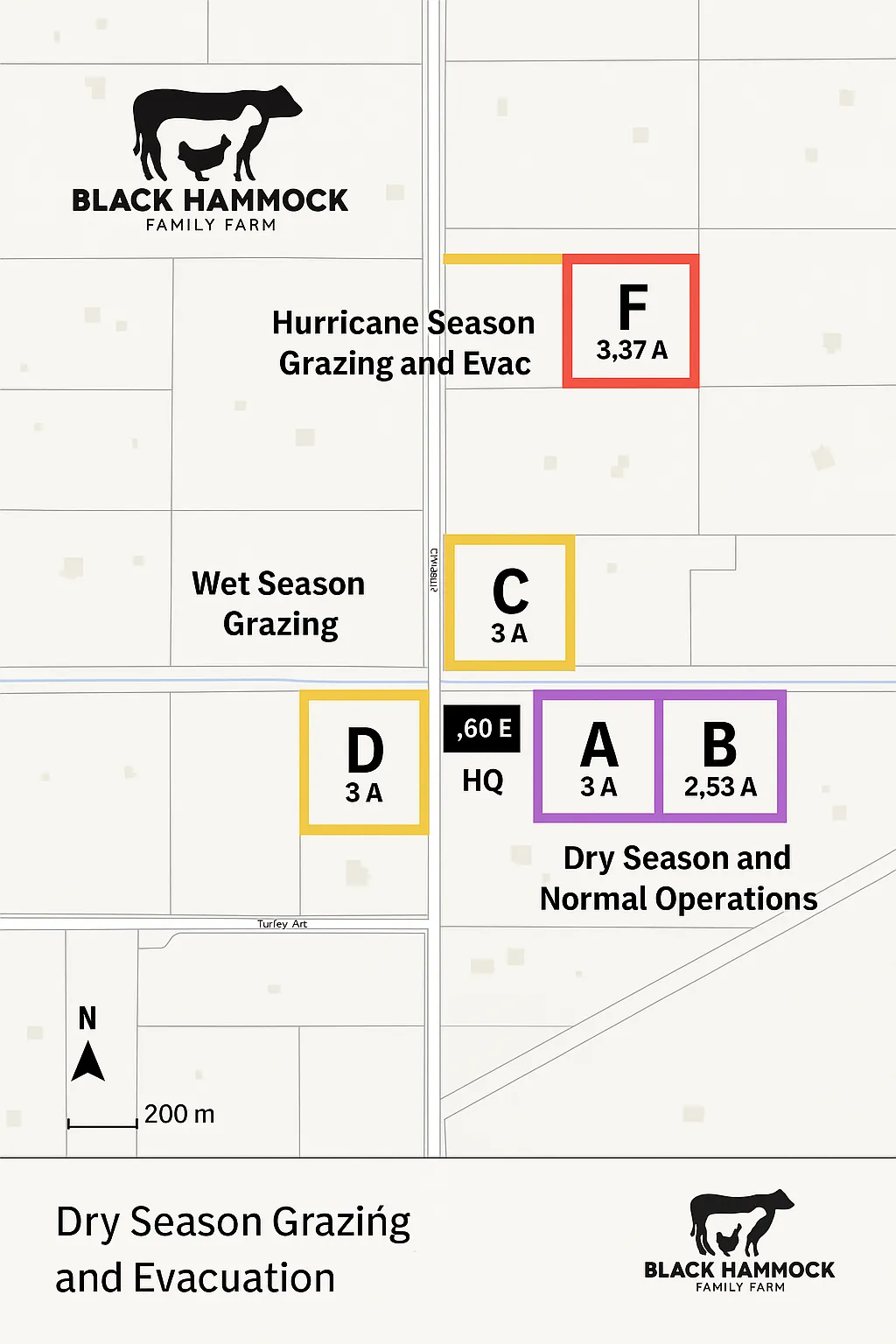
Black Hammock Farm operates a strategic rotational grazing system across six distinct pasture zones totaling approximately 12.5 acres. Each pasture serves a specific purpose based on seasonal conditions, drainage characteristics, and accessibility during Florida's variable weather patterns.
Total Farm Layout
Sheep should be FAMACHA scored every 1 to 3 weeks during peak Haemonchus contortus transmission season. When scores trend higher indicating growing infection, animals should be scored every 7-10 days.
• Pasture A: 3.0 acres - Dry Season and Normal Operations
• Pasture B: 2.53 acres - Dry Season and Normal Operations
• Pasture C: 3.0 acres - Wet Season Grazing
• Pasture D: 3.0 acres - Wet Season Grazing
• Pasture F: 3.37 acres - Hurricane Season Grazing and Evacuation
• Headquarters (HQ): 0.60 acres - Operations center, feed room, handling facilities
Why Rotational Grazing Matters:
A grass or clover plant that is nibbled on every few days has little time to recover from the grazing injury before being injured again. It loses root mass and energy reserves and has greatly reduced forage production. A plant able to recover from a single grazing incident for three weeks or more before being grazed again has more resources for growth and can produce 30-70% more forage.
• Better pasture quality—animals given less time to graze won't damage plants excessively or eradicate favored species while promoting increased growth.
• Fewer parasites—moving sheep constantly limits parasites' ability to find hosts, reducing worm burdens over time.
• More even manure distribution across the entire pasture.
• Ability to control and limit feed for dry ewes and early gestation ewes, saving best forage for growing lambs and lactating ewes.
• Improved soil fertility through controlled grazing impact.
• Higher stocking rates on same acreage.
Individual Pasture Descriptions
PASTURE A (3.0 Acres) - Purple Zone
Primary Use: Dry Season and Normal Operations
Characteristics:
• Well-drained elevated ground
• Excellent drainage during heavy rainfall
• Full sun exposure with minimal shade
• Prime grazing area during normal weather conditions
• Easy access from headquarters
Best For:
• November through May (dry season)
• Lactating ewes requiring high-quality forage
• Growing lambs needing premium nutrition
• Breeding stock during preparation season
• Year-round use when weather permits
Management Notes:
• Monitor closely for parasite pressure due to frequent use
• Can handle higher stocking density than wet season pastures
• Rotate every 3-7 days depending on flock size and forage height
• Allow minimum 21-day rest period between grazing November through May (dry season)
PASTURE B (2.53 Acres) - Purple Zone
Primary Use: Dry Season and Normal Operations
Characteristics:
• Good drainage with slightly lower elevation than Pasture A
• Mixed sun and partial shade areas
• Smaller acreage requires careful stocking calculations
• Adjacent to operations area for easy monitoring
Best For:
• November through May (dry season)
• Smaller groups (rams, dry ewes, weaned lambs)
• Finishing lambs before market
• Quarantine area for new arrivals when needed
• Recovery pasture for animals under veterinary care
Management Notes:
• Size requires more frequent rotation (2-4 days maximum)
• Ideal for "leader-follower" system where growing lambs get first access
• Monitor soil compaction in high-traffic areas
• Rest minimum 21-28 days between grazing
PASTURE C (3.0 Acres) - Yellow Zone
Primary Use: Wet Season Grazing
Characteristics:
• Moderate drainage with some low-lying areas
• Flood-tolerant forage species
• Designated for June through October use
• Can handle standing water better than dry season pastures
Best For:
• Wet season rotation (June-October)
• Managing flock during Florida's rainy season
• Maintaining hoof health through rotation away from saturated areas
• Reducing parasite exposure on drier ground
Management Notes:
• Do not graze while being irrigated or until soils have dried after heavy rain
• Monitor for signs of soil damage (pugging, compaction)
• Move animals to higher ground if standing water persists >24 hours
• May require longer rest periods (28-35 days) during wet season
• Watch for increased parasite pressure—FAMACHA score weekly
PASTURE D (3.0 Acres) - Yellow Zone
Primary Use: Wet Season Grazing
Characteristics:
• Similar drainage profile to Pasture C, but dryer and heigher.
• Strategic location for wet season rotation
• Backup wet season option when C needs extended rest
• Mixed forage types suited to variable moisture
Best For:
• Wet season rotation (June-October)
• Alternating with Pasture C for optimal rest periods
• Dry ewes and non-lactating animals during challenging weather
• Stockpiling forage for early fall grazing
Management Notes:
• Coordinate rotation with Pasture C to ensure one is always resting
• Use weather forecasts to decide paddock placement—plan moves to higher ground when rainfall exceeds 5 inches in one week
• Avoid grazing below 4 inches during growing season
• Monitor for hoof problems (foot rot, foot scald) in wet conditions
PASTURE F (3.37 Acres) - Red Zone
Primary Use: Hurricane Season Grazing and Evacuation
Characteristics:
• Highest elevation on property
• Maximum distance from roadways and property boundaries
• Multiple fence lines between pasture and external boundaries
• Secure location for extreme weather events
• Can accommodate entire flock if necessary
Best For:
• Hurricane season preparedness (June 1 - November 30)
• Emergency evacuation and consolidation of flock
• Secure grazing when tropical systems threaten
• Backup pasture during peak storm season
• High-value breeding stock protection
Management Notes:
• Move animals to interior pastures so there are multiple fences between animals and highways or neighbors during storms
• Keep this pasture in reserve rotation during hurricane season
• Ensure water access functions without electricity (gravity-fed or hand pump)
• Stock 7-14 days of feed, forage, supplements, and clean water before storms
• Pre-position emergency supplies accessible from this location
• Clear of large trees that could damage fencing during high windsCoordinate rotation with Pasture C to ensure one is always resting
HEADQUARTERS (0.60 Acres) - Black Zone
Primary Use: Operations Center
Facilities Include:
• Feed room and storage
• Handling equipment and chutes
• Medical supplies and treatment area
• Record keeping station
• Equipment storage
• Water distribution hub
Not For Grazing:
• High-traffic area with soil compaction
• Sacrifice area" that protects pasture quality and animal during extreme weather events
• Animals only present for handling, treatment, or temporary holding
Daily Grazing Management Protocols
Rotation Timing
Research has conclusively shown that you get more production from your land when you rotate frequently, with significant increases in tonnage grown, animals grazed per acre, and profitability.
Optimal Rotation Schedule:
• Ideal: Every 2-3 days
• Acceptable: Every 3-5 days during peak growth
• Maximum: 7 days (only during wet season for parasite control)
• Never exceed 7 days in one paddock—this is not true rotational grazing
How to Determine When to Move:
Plants should be grazed when 4-6 inches tall and rotated out when grazed to about 2-3 inches. The rule of thumb for most plants is not to graze below a minimum of 2 inches.
Visual Assessment:
• Walk the pasture daily
• Check forage height in multiple locations
• Observe grazing patterns—sheep returning to favorite spots repeatedly?
• Look at residual after grazing—too short indicates overgrazing
• If you see four inches of good residual with consistent grazing and manure distribution, timing is right
Stocking Density Calculations
Leader-Follower System: Save the best forage for the class of sheep that needs it most. Newly weaned lambs can be put on best forage first to "cherry-pick" highest quality, then move dry ewes onto same grass after lambs removed the premium forage.
Spring (March - May)
Focus: Renovation and Growth
• Overseed bare areas in resting pastures
• Fertilize annually—adequate P, K, and S should be applied at rates determined by soil analysis
• Clip/mow excessive mature growth after animals rotate out
• Monitor for weed pressure and address early
• Prepare wet season pastures (C & D) for upcoming use
• Soil test every 2-3 years
Summer (June - August)
Focus: Wet Season Management and Parasite Control
• Move sheep relentlessly across pastures, never exceeding 7 days per paddock
• Monitor for standing water and soil damage
• Move animals every 1-2 days to fresh pasture to avoid damage from staying in one spot 3+ days
• Allow dry season pastures (A & B) to rest and stockpile
• Maintain water systems critical during high heat
• Mow or graze down excessive growth to maintain quality
Fall (September - November)
Focus: Transition and Hurricane Preparation
• Graze stockpiled forage from summer—can graze longer (7-30 days) as forage goes dormant.
• Gradually transition back to dry season pastures
• Conduct hurricane preparedness drills and checks
• Repair and reinforce fencing before storm season peak
• Final fertilizer application for winter growth
• Clear Pasture F of any debris
Winter (December - February)
Focus: Protection and Rest
• Unless you have large acreage, grass needs protection from grazing in winter
• Concentrate grazing on Pastures A & B
• UGraze pasture down hard in spring if planning to renovate, then broadcast seed and chain drag
• UAllow wet season pastures complete winter rest
• UPlan spring renovations during this slower period
• Order seeds, supplies for spring maintenanceGraze stockpiled forage from summer—can graze longer (7-30 days) as forage goes dormant
1579 Walsh Street Oviedo,
Florida 32765
COMPANY
FARM SERVICES
LIVESTOCK PROGRAMS
FOLLOW US


POWERED BY:

© 2025 Black Hammock Family Farm. All rights reserved.
1579 Walsh Street Oviedo,
Florida 32765
COMPANY
FARM SERVICES
LIVESTOCK PROGRAMS
FOLLOW US
POWERED BY:
© 2025 Black Hammock Family Farm.
All rights reserved.